
Markets Are Flying High… But the Storm Is Building Beneath

Markets Are Flying High… But the Storm Is Building Beneath

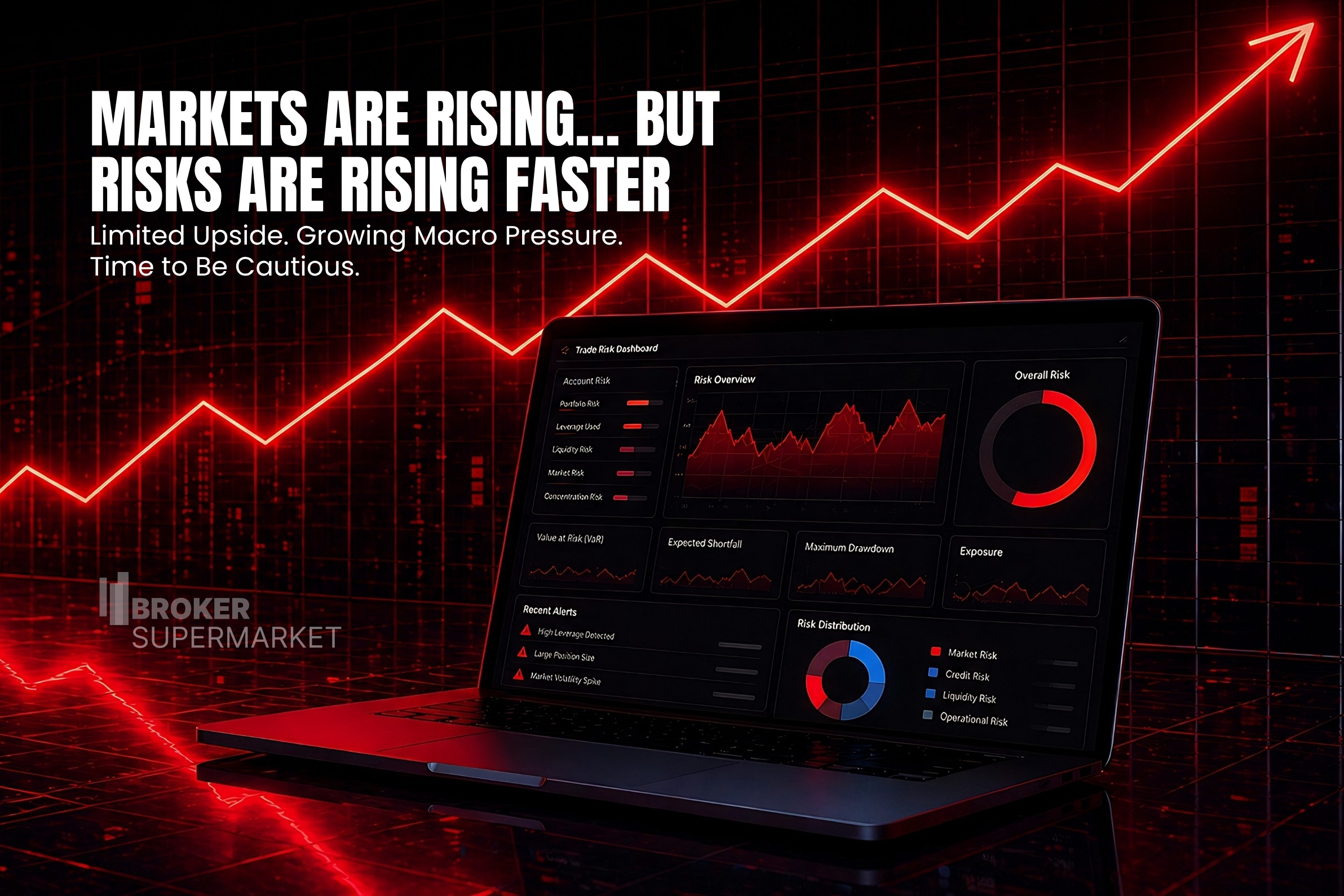
At first glance, everything looks perfect.
Stock markets are hovering near record highs. Momentum is strong. Investors seem confident. And despite geopolitical tensions and rising costs, equities continue to hold their ground.
But look closer — and a very different story begins to unfold.
This is not a typical bull market.
This is a market driven by optimism… while quietly ignoring reality.
The Illusion of Strength
Markets today are behaving in a way rarely seen before.
Even as oil prices surge, global tensions rise, and economic pressures build, indices remain elevated. Normally, such conditions would trigger a correction — or at the very least, a caution.
Instead, we’re seeing resilience.
But this strength is not entirely organic.
A significant portion of the rally appears to be driven by momentum-based strategies — large institutional flows that chase trends rather than fundamentals. When billions of dollars enter markets simply because prices are rising, it creates a self-reinforcing loop.
Prices go up… because money keeps pushing them up.
That’s not stability.
That’s acceleration.
When Markets and Reality Diverge
One of the clearest warning signs today is the disconnect between markets and the real economy.
On one side, equity markets are near their peaks.
On the other, consumer confidence is weak — signaling underlying stress.
This kind of divergence is rare.
Consumers are the backbone of economic growth. If sentiment is falling, spending is unlikely to remain strong for long. And when spending slows, growth follows.
Markets may be celebrating — but the economy is hesitating.
The Temporary Nature of Economic Strength
Recent economic data has added to the optimism.
Retail sales have improved. Growth projections have ticked higher. On paper, the economy appears resilient.
But dig deeper, and the strength looks temporary.
Much of the recent boost has been supported by short-term factors — not sustainable momentum. At the same time:
- Real wage growth is barely keeping pace with inflation
- Consumer contribution to growth is declining
- Financial pressure on households is gradually increasing
In other words, the foundation is weakening — even as the surface looks strong.
Rising Costs, Global Pressures, and the Inflation Problem
Beyond domestic factors, global developments are adding fuel to the fire.
Disruptions in key trade routes have pushed energy prices higher. This is not just about oil — it impacts transportation, manufacturing, and supply chains across industries.
As costs rise, businesses face increasing pressure.
And eventually, those costs are passed on to consumers.
This is how inflation spreads — slowly at first, then all at once.
The Growing Risk of Stagflation
What makes the current environment particularly complex is the combination of two opposing forces:
- Slowing economic growth
- Rising inflation
Together, they form a challenging scenario known as stagflation.
In such an environment, businesses struggle with higher costs and weaker demand. Investment slows. Hiring weakens. Profit expectations come under pressure.
And yet — markets are not fully pricing this in.
A Market With Limited Upside — and Limited Downside
Despite these risks, the outlook is not entirely negative.
Corporate earnings, particularly in select sectors, continue to provide support. This reduces the likelihood of a sharp and immediate market decline.
But it also limits the upside.
Because while earnings may hold steady, macroeconomic headwinds cap growth potential.
The result?
A market that is neither poised for a major breakout nor an immediate collapse.
Instead, it exists in a narrow band — driven by optimism, but constrained by reality.
Why This Matters Now
The current market environment is defined by one key factor: expectations.
Investors are pricing in positive outcomes — resolution of conflicts, easing inflation, continued earnings strength. But many of these assumptions remain uncertain.
When expectations run ahead of reality, markets become fragile.
Not because they are weak — but because they are unprepared.
The Real Signal: Euphoria Is a Warning
Market euphoria often feels like confidence.
But in many cases, it is a signal of complacency.
When risks are visible but ignored…
When optimism outweighs data…
When prices rise faster than fundamentals…
It is not a sign of strength.
It is a signal to pause.
What Investors Should Watch Closely
In the coming months, the direction of the market will depend less on momentum — and more on macroeconomic reality.
Key indicators to watch include:
- Energy prices and supply disruptions
- Inflation trends across sectors
- Consumer spending and wage growth
- Business investment and employment trends
If these begin to deteriorate, the current balance could quickly shift.
The Bottom Line
This is a market caught between two forces:
- Optimism driving prices higher
- Economic reality pulling expectations lower
For now, neither side has fully taken control.
But that balance will not last forever.
Because in the end, markets don’t just follow momentum —
they follow reality.
Closing Insight
The market may not be at risk of a sharp fall today.
But it is also not positioned for meaningful upside.
And in an environment where both opportunity and risk are limited,
the smartest move is not to chase the market…
…but to understand it.

October 07, 2026 06:59:36am

September 29, 2026 12:01:47pm
September 16, 2026 09:12:38am

September 08, 2026 06:57:20am

September 02, 2026 08:40:28am

August 27, 2026 10:22:44am

August 19, 2026 12:24:43pm

August 12, 2026 07:33:28am
 en
en es
es th
th vi
vi zh
zh