
The Hidden Cost of “Cheap” Trading: What Are You Really Paying Your Broker?

The Hidden Cost of “Cheap” Trading: What Are You Really Paying Your Broker?

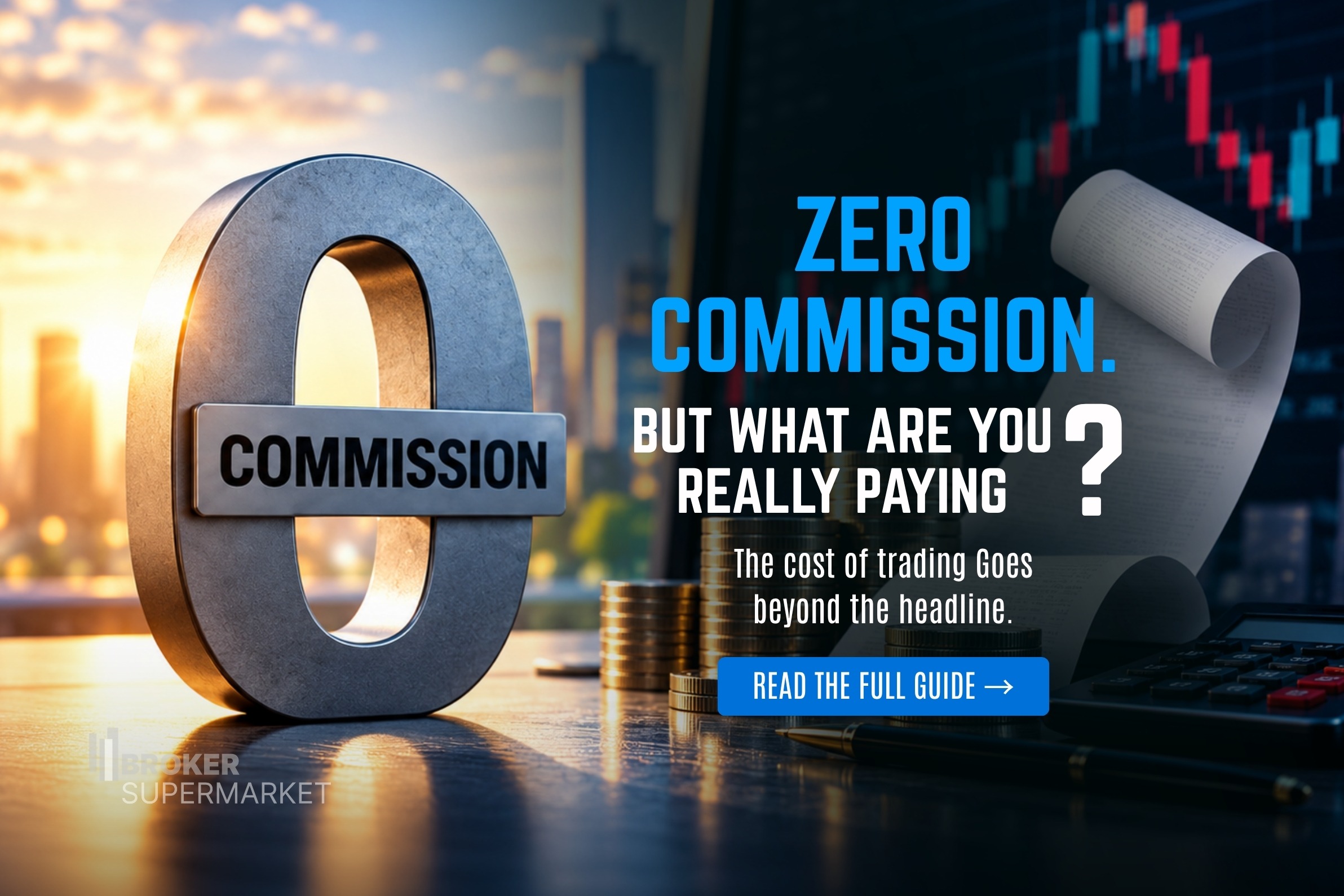
“Low commissions.”
“Zero commission.”
“Competitive spreads.”
These phrases are everywhere in online trading.
And at first glance, choosing the broker with the lowest advertised cost seems simple.
But here’s the question worth asking:
A broker can advertise low trading costs. But is that the whole story?
Not necessarily.
The cost of trading can involve more than one charge. Depending on the broker, product and account, traders may encounter commissions, spreads and other applicable fees.
So instead of looking for the broker with the biggest “0”, it can be more useful to understand the full cost structure.
Let’s break it down.
What Are Broker Fees?
Broker fees are the charges associated with using a broker’s services.
The exact fees can vary considerably between brokers and can also depend on the financial product, account type and type of transaction.
Common costs may include:
-
Commissions
-
Spreads
-
Account-related fees
-
Deposit or withdrawal fees
-
Currency conversion costs
-
Inactivity fees
-
Other applicable charges
Not every broker charges every type of fee.
That’s why simply comparing one advertised number can give you an incomplete picture.
The real question is:
“What could I pay across the entire trading experience?”
1. Commission: The Cost You Can See
Commission is probably the easiest trading cost to understand.
A broker may charge a commission when you buy or sell certain financial instruments.
For example, a broker might advertise a specific commission per transaction or according to the size of a trade.
This makes commission relatively straightforward to compare.
But here’s where things get interesting:
A low commission doesn’t automatically mean low overall trading costs.
Why?
Because commission can be only one part of the pricing structure.
You may also need to consider spreads and other applicable charges.
2. Spread: The Cost Hidden Between Two Prices
If you’ve ever looked at a trading platform and seen two prices for the same instrument, you’ve probably encountered the concept of a spread.
The spread is the difference between the bid and ask prices.
For example:
Bid: 100.00
Ask: 100.05
The difference is:
0.05
That difference represents the spread.
Depending on the financial product and broker, the spread can be an important component of trading costs.
This is particularly relevant when comparing brokers that advertise commission-free trading.
Because:
No commission doesn’t necessarily mean no trading cost.
3. What Does “Commission-Free Trading” Really Mean?
This is one of the most common questions traders ask:
“Is commission-free trading really free?”
The short answer is:
Not necessarily.
“Commission-free” generally means the broker isn’t charging a separate commission on the relevant transaction under the stated conditions.
But that doesn’t automatically mean there are no other costs.
For example, depending on the broker and product, pricing may involve:
-
Spreads
-
Currency conversion costs
-
Other applicable fees
-
Account-related charges
-
Other transaction costs
So when you see:
“ZERO COMMISSION”
Don’t stop there.
Ask:
“What other costs apply?”
That question can give you a much better understanding of the actual pricing structure.
4. Account Fees Can Be Part of the Picture
Trading costs aren’t always connected directly to buying or selling.
Some brokers may have other account-related charges depending on the account and service.
These could include fees associated with:
-
Account maintenance
-
Inactivity
-
Certain services
-
Data or platform-related services
-
Other account features
The specific charges vary between brokers.
This is why reading the broker’s current fee schedule and account terms matters.
5. Deposits and Withdrawals Can Have Costs Too
Here’s another area that can easily be overlooked.
You might focus entirely on:
“How much does it cost to trade?”
But what about moving money into or out of your trading account?
Depending on the broker and payment method, there may be applicable charges related to:
-
Deposits
-
Withdrawals
-
Payment methods
-
Currency conversion
These costs may not affect every trader in the same way.
But if you’re comparing brokers, they can still be worth checking.
6. Currency Conversion: The Cost You May Not Notice
Imagine your account is denominated in one currency, but you want to trade or fund your account using another.
Currency conversion may then become relevant.
The cost can depend on:
-
The currencies involved
-
The broker
-
The transaction
-
The applicable exchange rate or conversion charge
For traders dealing with international markets, this is an important part of understanding the overall cost.
A broker can appear inexpensive from a trading-commission perspective while other costs may still matter to you.
7. Different Traders Can Experience Different Costs
This is one of the most important points.
There isn’t necessarily one broker that is “cheapest” for everyone.
Why?
Because trading behaviour differs.
Imagine two traders.
Trader A
Trades occasionally and holds positions for longer periods.
Trader B
Trades frequently and pays close attention to transaction costs.
They may care about completely different parts of a broker’s pricing structure.
For one trader, a particular fee may barely matter.
For another, the same fee could become much more significant.
So instead of asking:
“Which broker has the lowest fees?”
A better question may be:
“Which broker’s pricing structure makes sense for how I plan to trade?”
8. Why the Headline Price Isn’t Always Enough
Marketing makes comparison look simple.
You might see:
0% commission
or
Low spreads
or
Competitive pricing
But these statements don’t necessarily tell you everything you need to know.
Before comparing brokers, look at the details behind the headline.
Consider:
What product are you trading?
How often are you trading?
What is the spread?
Is there a commission?
Are there account-related charges?
Are there deposit or withdrawal costs?
Could currency conversion apply?
The answers can change the overall picture.
9. The Difference Between “Cheap” and “Suitable”
This distinction is easy to miss.
A broker may have an attractive headline price.
But if it doesn’t offer the markets you want, the platform you prefer or the account features you need, the low price may not be particularly useful.
Think about it like this:
Broker A
Lower advertised trading cost
❌ Doesn’t offer the market you’re interested in
Broker B
Slightly different pricing
✓ Offers the market you want
✓ Platform suits your preferences
✓ Account features fit your needs
Which one is more relevant?
The answer depends on what you’re looking for.
That’s why broker fees comparison shouldn’t happen in isolation.
10. So, How Should You Compare Broker Fees?
Instead of searching for a single “cheapest broker,” create a broader picture.
Start with the product.
What do you want to trade?
Look at the commission.
Is there a commission? If so, how is it charged?
Check the spread.
How does the bid-ask spread affect the cost?
Look beyond trading.
Are there other applicable account, deposit, withdrawal or conversion charges?
Consider your trading frequency.
Would certain costs matter more based on how often you trade?
Read the details.
Always check the broker’s current pricing information, terms and conditions.
This gives you a more meaningful basis for comparison.
A Simple Broker Cost Checklist
Before opening a trading account, ask:
COMMISSION
Is there a commission?
SPREAD
What spread applies?
ACCOUNT
Are there account-related charges?
FUNDING
Are there deposit or withdrawal fees?
CURRENCY
Could currency conversion costs apply?
OTHER
Are there additional charges relevant to the products or services I plan to use?
The goal isn’t to find a broker with zero costs.
The goal is to understand what the costs actually are.
Why “Free” Isn’t Always the Most Important Number
A zero can look impressive.
But a single number rarely tells the entire story.
When comparing online trading costs, context matters.
Zero commission may be useful.
Low spreads may be useful.
But neither should automatically be treated as proof that one broker is the right choice for every trader.
The more useful approach is to look at the overall pricing structure and how it relates to your own trading needs.
What Should You Check Before Choosing a Broker?
If you’re comparing online brokers, don’t stop at the headline fee.
Look at:
-
Markets: What can you trade?
-
Platform: How do you access the market?
-
Commission: What transaction charges apply?
-
Spreads: What is the difference between bid and ask?
-
Account: What requirements and features apply?
-
Funding: What costs could apply when moving money?
-
Currency: Could conversion costs affect you?
-
Other fees: Are there additional charges relevant to your account or products?
Together, these give you a much clearer picture.
The Real Cost of Trading Isn’t Always One Number
There is no universal “trading cost” that applies to every trader.
The total cost can depend on the broker, product, account, transaction and trading behaviour.
That’s why understanding broker fees is more useful than simply searching for the lowest advertised price.
Before you choose, ask:
What am I actually paying?
Then ask:
Does that pricing structure make sense for me?
Those two questions can change the way you compare brokers.
Compare Beyond the Headline
Finding a broker isn’t only about looking for the word “free.”
It’s about understanding the full picture.
At Broker Super Market, you can explore different brokers and compare key information to help you understand your available options.
🔎 Explore brokers and compare your options with Broker Super Market.
Don’t just look at the headline price.
Look at what’s behind it.

October 07, 2026 06:59:36am

September 29, 2026 12:01:47pm
September 16, 2026 09:12:38am

September 08, 2026 06:57:20am

September 02, 2026 08:40:28am
August 27, 2026 10:22:44am

August 19, 2026 12:24:43pm

August 12, 2026 07:33:28am
 en
en es
es th
th vi
vi zh
zh